



Food Grade 304 Stainless Steel IBC For Beverage and Edible Oil Storage


If you store or ship beverages, edible oils, syrups, or dairy, you need more than just a tank. You need a food grade 304 stainless steel ibc that won’t alter taste, won’t harbor bacteria, and can be cleaned between batches.
Not every IBC Tank labeled “stainless steel” is truly food grade. The difference is in the surface finish, the welds, and the documentation.
We’ve supplied 304 stainless steel ibc tanks to juice plants, dairies, edible oil refineries, and breweries across 23 countries. This guide explains what food grade really means – and why it matters for your product.
See our food grade 304 stainless steel IBC for beverage and edible oil applications.

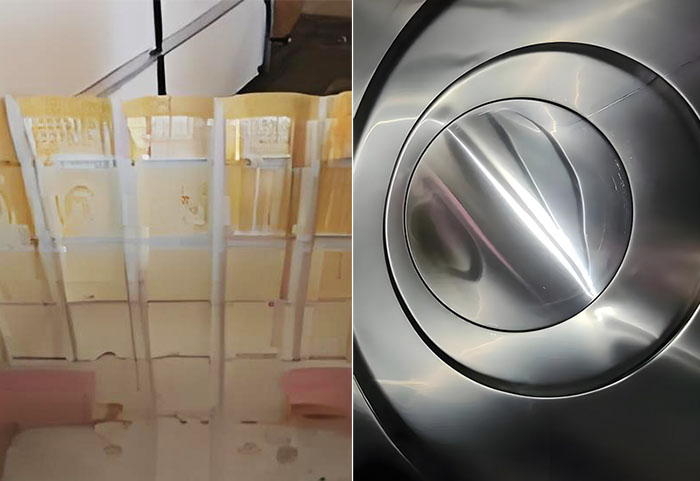
Bottom display of food-grade 304 stainless steel Intermediate Bulk Container (IBC) after application
1. What Does “Food Grade” Actually Mean?
A food grade 304 stainless steel ibc is not just a tank made of 304 material. It must meet three specific requirements:
Requirement | What It Means | Why It Matters |
|---|---|---|
Surface finish | Interior polished to Ra ≤ 0.8µm (mirror-like) | No scratches for bacteria to hide |
Weld quality | Fully penetrated, ground flush, smooth | No crevices for residue to collect |
Material certification | 3.1 mill certificates, FDA compliant | Proof the steel is safe for food contact |
A standard industrial IBC Tank with a rough 2B finish may look clean, but under a microscope, the surface has valleys where bacteria can survive cleaning. Food grade polishing removes those valleys.
A dairy quality manager in Wisconsin told us: “We switched to food grade 304 IBCs. Our lab tests for bacteria went from ‘occasional positive’ to zero – for three years straight.”

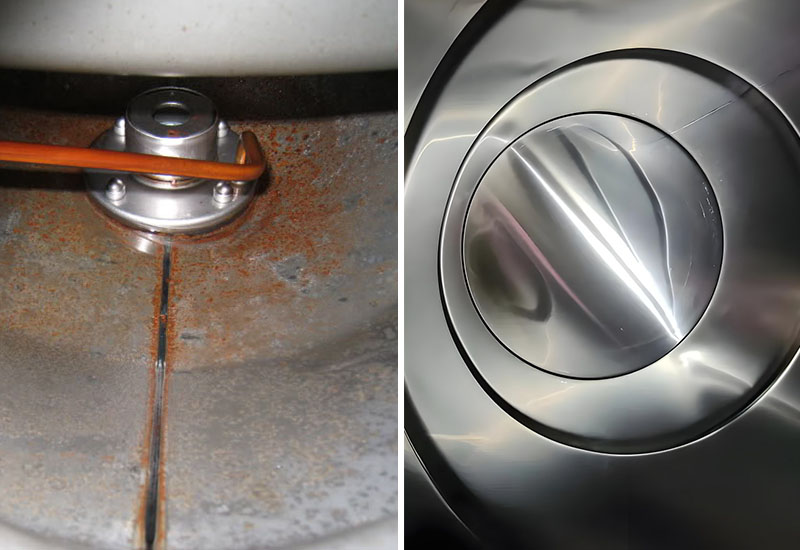
Internal comparison between food-grade stainless steel ton barrels and non-food-grade ton barrels after use
2. Which Beverages and Oils Need Food Grade 304 IBC?
Any product that humans consume. But the risk level varies.
Product | Why Food Grade Matters | Typical Use |
|---|---|---|
Edible oils (olive, palm, sunflower) | Oil can absorb flavors from previous batches | Bulk transport, refinery storage |
Fruit juices | Bacteria risk if surface not smooth | Concentrate storage, blending |
Syrups (corn, maple, agave) | High sugar content attracts microbes | Sweetener storage |
Dairy (milk, cream, yogurt) | Highest bacteria risk | Raw milk holding, CIP |
Beer and wine | Off-flavors ruin product | Fermentation, aging, transport |
Water (spring, mineral) | Consumer expects pure taste | Bottling lines |
A juice plant in Thailand switched from standard 304 to food grade 304 stainless steel ibc. Their quality manager: “No more plastic aftertaste. Our customers noticed within a month.”

Application of food-grade stainless steel ton barrels in breweries
3. Food Grade Surface Finish: What Ra ≤ 0.8µm Means
The most common spec for 304 ibc for beverage applications is Ra ≤ 0.8µm.
What is Ra? Ra (Roughness Average) measures the average height of surface irregularities. Lower number = smoother surface.
Ra Value | Visual | Use Case |
|---|---|---|
≥ 1.0µm | Visible scratches | Industrial chemicals |
0.8µm | Mirror-like, no visible scratches | Food grade standard |
0.4µm | Ultra-smooth | Pharma / high-purity |
0.2µm | Electropolished | Biotech / injectables |
For edible oil storage and most beverages, Ra ≤ 0.8µm is the accepted standard. It’s smooth enough to clean thoroughly but not so polished that it adds unnecessary cost.
How we achieve it: After welding, the interior is mechanically polished using graduated abrasives, then finished with a fine buffing wheel. Every food grade 304 stainless steel ibc is measured with a profilometer. We provide the Ra value in your documentation package.
Learn more about food grade surface finish requirements for IBC tanks.
4. Capacity Options: 500L to 1500L – All Food Grade
We manufacture food grade 304 stainless steel ibc tanks in all standard capacities:
Capacity | Best For | Typical Customer |
|---|---|---|
500L | R&D, small batches, samples | Flavor houses, craft breweries |
1000L | Standard production | Juice plants, dairies, refineries |
1200L | Shipping efficiency (same footprint, 20% more) | Exporters, large-scale beverage |
1500L | Stationary storage | Bulk oil storage, large dairies |
All capacities include:
Interior polished to Ra ≤ 0.8µm
Fully penetrated, ground welds
3.1 material certificates
50mm ball valve with EPDM seals (FDA grade)
DN159 top cover
Browse all food grade IBC tanks by capacity – from 500L to 1500L.
5. Cleaning: How to Keep Food Grade IBCs Food Grade
A food grade 304 stainless steel ibc stays food grade only if you clean it properly.
Recommended CIP cycle for food grade IBC:
Step | Action | Time | Temperature |
|---|---|---|---|
1 | Pre-rinse with water | 3-5 min | Ambient |
2 | Alkaline wash (1-2% NaOH) | 10-15 min | 70-80°C |
3 | Intermediate rinse | 3-5 min | Ambient |
4 | Acid rinse (0.5-1% nitric or phosphoric) | 5-10 min | 60-70°C |
5 | Final rinse with potable water | 3-5 min | Ambient |
Never do:
Use abrasive pads or steel wool (scratches ruin the food grade surface)
Leave acidic or caustic residues overnight (can pit the surface)
Mix cleaning chemicals without knowing compatibility
A brewery in Oregon follows this exact cycle. Their quality team told us: “We test for wild yeast and bacteria every batch. Zero contamination in four years.”
6. Exporting Food Grade 304 IBC: What Documents You Need
As an experienced stainless steel ibc exporter, we know what food industry customers require for import.
Required documents for food grade IBC export:
Document | Purpose |
|---|---|
3.1 mill certificate | Proves 304 grade and traceability |
FDA certificate | Confirms material meets food contact standards |
Surface finish report | Shows Ra value (must be ≤ 0.8µm) |
Weld map | Shows all interior seams are smooth |
Pressure test report | Verifies no leaks |
We provide all of these with every 304 stainless steel ibc shipped to food industry customers. No missing papers, no customs delays.
We’ve exported food grade 304 stainless steel ibc to 23 countries – including USA, Canada, Australia, Germany, and Japan.
7. Common Mistakes We See
Mistake #1: Buying “stainless steel IBC” without checking surface finish
Not every stainless IBC is food grade. Always ask for Ra value.
Mistake #2: Assuming 304 is automatically food grade
304 is the material. Food grade is the finish. Two different things.
Mistake #3: No documentation
Without 3.1 certificates and FDA paperwork, some countries will reject the shipment.
Mistake #4: Using abrasive cleaners
Steel wool or scouring pads destroy the mirror finish. Once scratched, bacteria can hide.
8. Summary: Food Grade 304 IBC at a Glance
Feature | What You Get |
|---|---|
Material | 304 stainless steel, FDA compliant |
Surface finish | Ra ≤ 0.8µm mirror polish |
Welds | Fully penetrated, ground smooth |
Capacities | 500L, 1000L, 1200L, 1500L (all in stock) |
Standard fittings | 50mm valve, DN159 cover, EPDM seals |
Documentation | 3.1 certs, FDA cert, surface finish report, weld map |
Export | 23 countries, full shipping support |
Need a Food Grade 304 Stainless Steel IBC?
We’ve supplied 304 stainless steel ibc tanks to juice plants, dairies, breweries, and edible oil refineries worldwide. Tell us your product, capacity, and destination.
We’ll provide a food grade IBC with full documentation – no surprises.
By Fulait Engineering Team
Shijiazhuang Fulait Packaging Co., LTD
Related Blogs
-
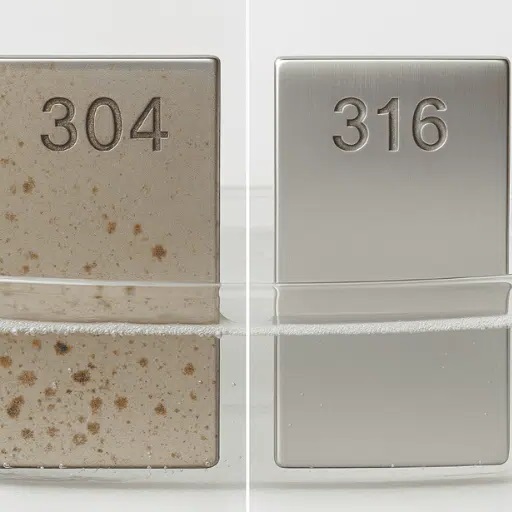 By Tom Chen, Sales Engineer at Flytech IBC(15 years in the stainless steel container industry)I'll never forget the call from a food processing plant in Ohio back in 2019.The owner was frustrated. He'd just spent nearly double on a fleet of 316 stainless steel IBCs because his "research" told him stTechnical Articles
 -
 Food grade 304 stainless steel IBC for beverages, edible oils, syrups, and dairy. Mirror-polished interior (Ra ≤ 0.8µm), FDA certified, full documentation. Used by juice plants, dairies, and breweries worldwide.Technical Articles
 -
 By the team at Shijiazhuang Fulait Packaging Co., LTDI'll be honest: most IBC cleaning guides online are useless.They tell you to "use appropriate cleaning solutions" and "rinse thoroughly." No kidding.Here's the real deal—what we've learned from watching customers ruin tanks, save tanks, and everytTechnical Articles
